Crypto Market Microstructure Research
Automated Analysis Using Kaiko Order Book Data (2017–2023) · Cornell University
I. Order Book Structure
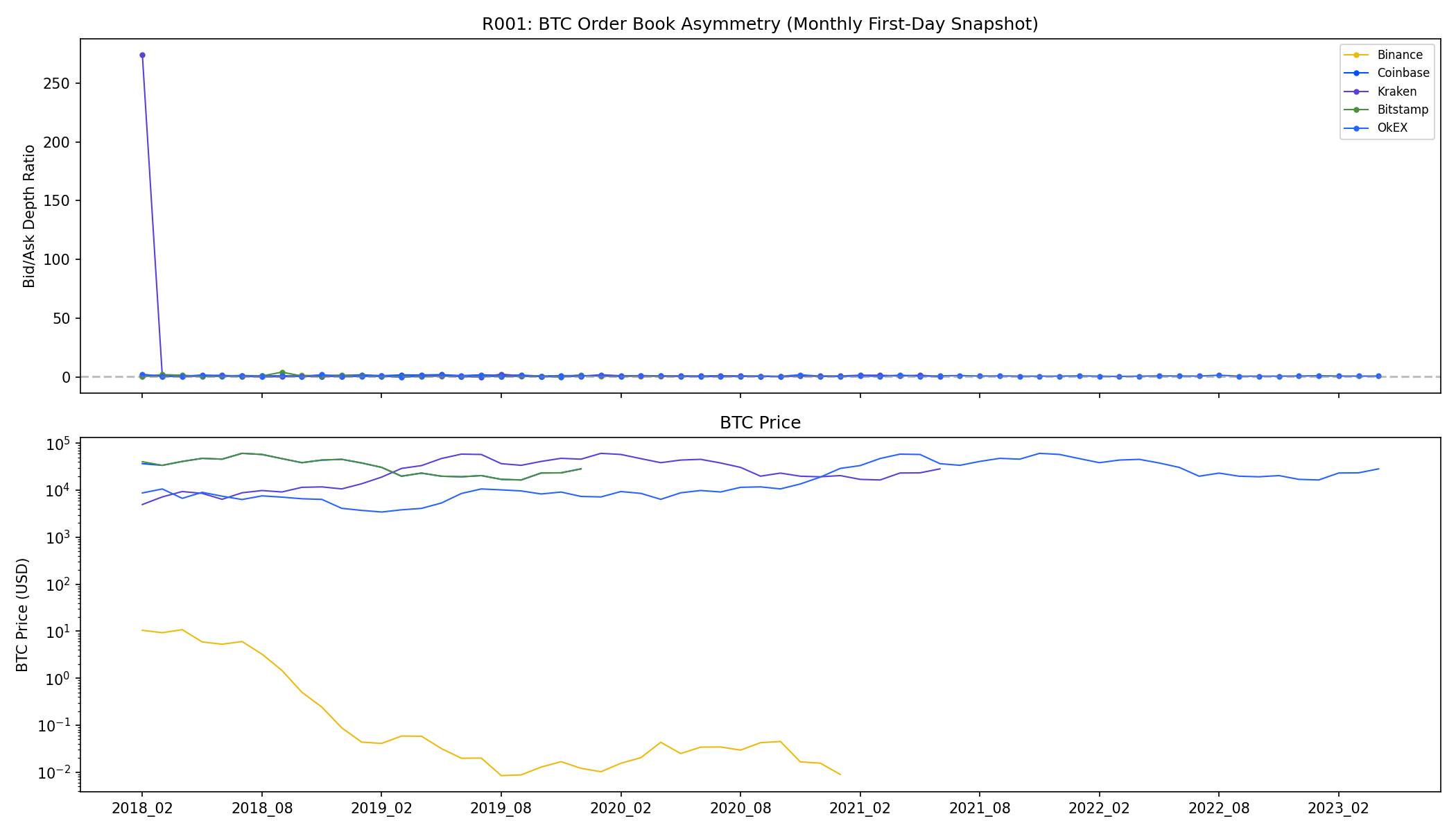
R001: Cross-Exchange Order Book Asymmetry
Kaiko OB Binance · Coinbase · Kraken · OkEX · Bitstamp | 2017–2023
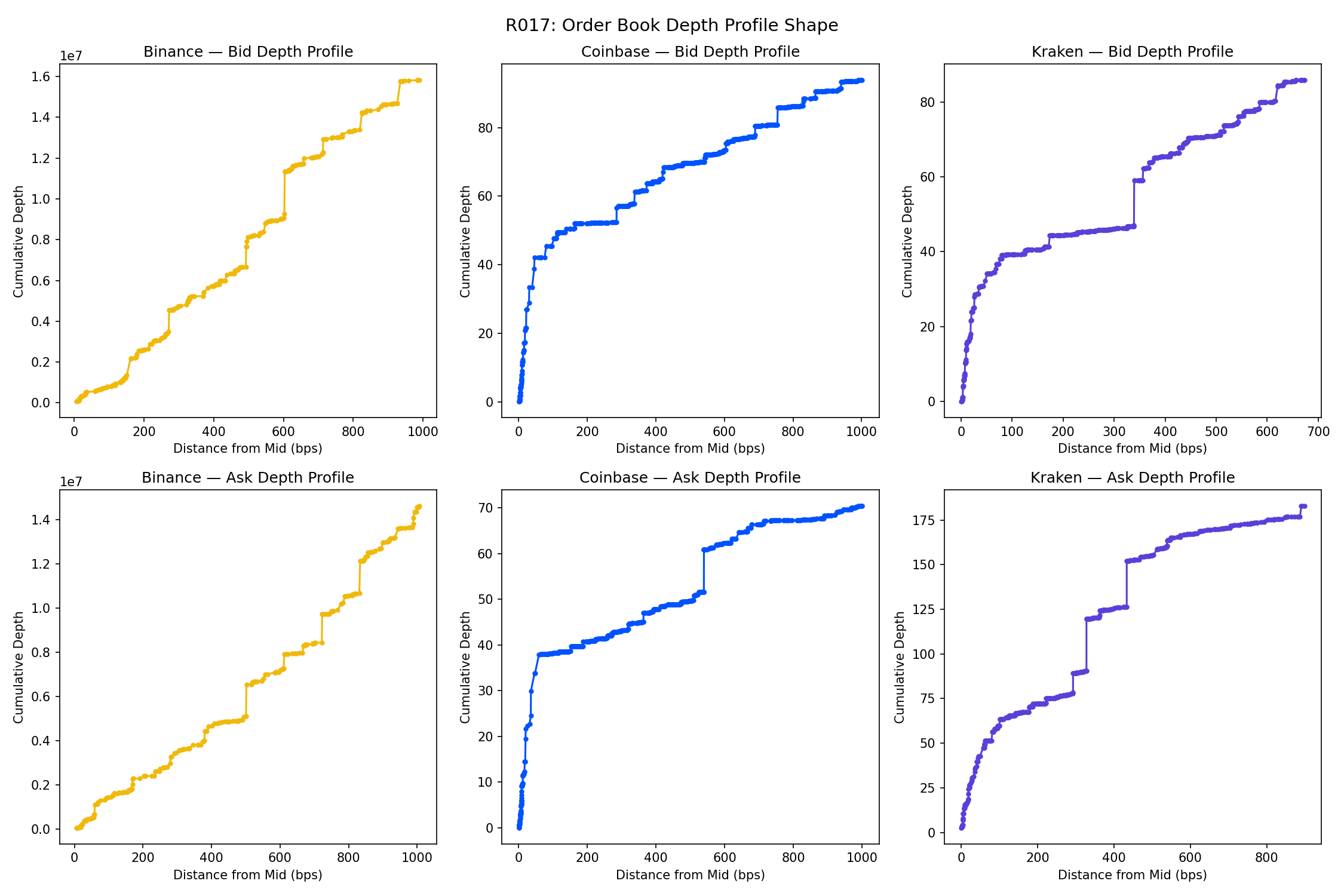
R017: Order Book Depth Profile
Kaiko OB Binance · Coinbase · Kraken | BTC-USD 2023-04
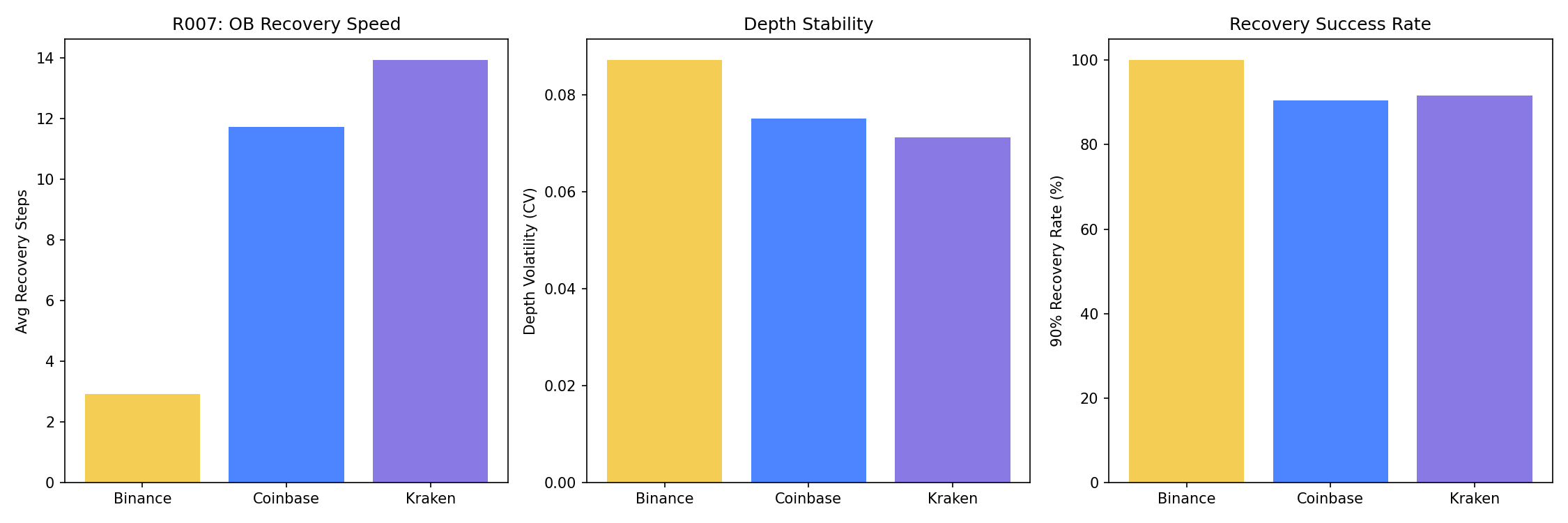
R007: Order Book Resilience After Shocks
Kaiko OB Spread recovery analysis | ±20% shock detection
R020: Multi-Asset Liquidity Comparison (Binance)
Kaiko OB BTC · SOL · DOGE · AVAX · MATIC | 2023
| Asset | Spread (bps) | OB Depth (USD) |
|---|---|---|
| MATIC | 0.9 | $8.7M |
| DOGE | 1.3 | $7.2M |
| SOL | 4.75 | $11.0M |
| AVAX | 5.65 | $4.4M |
II. Price Discovery
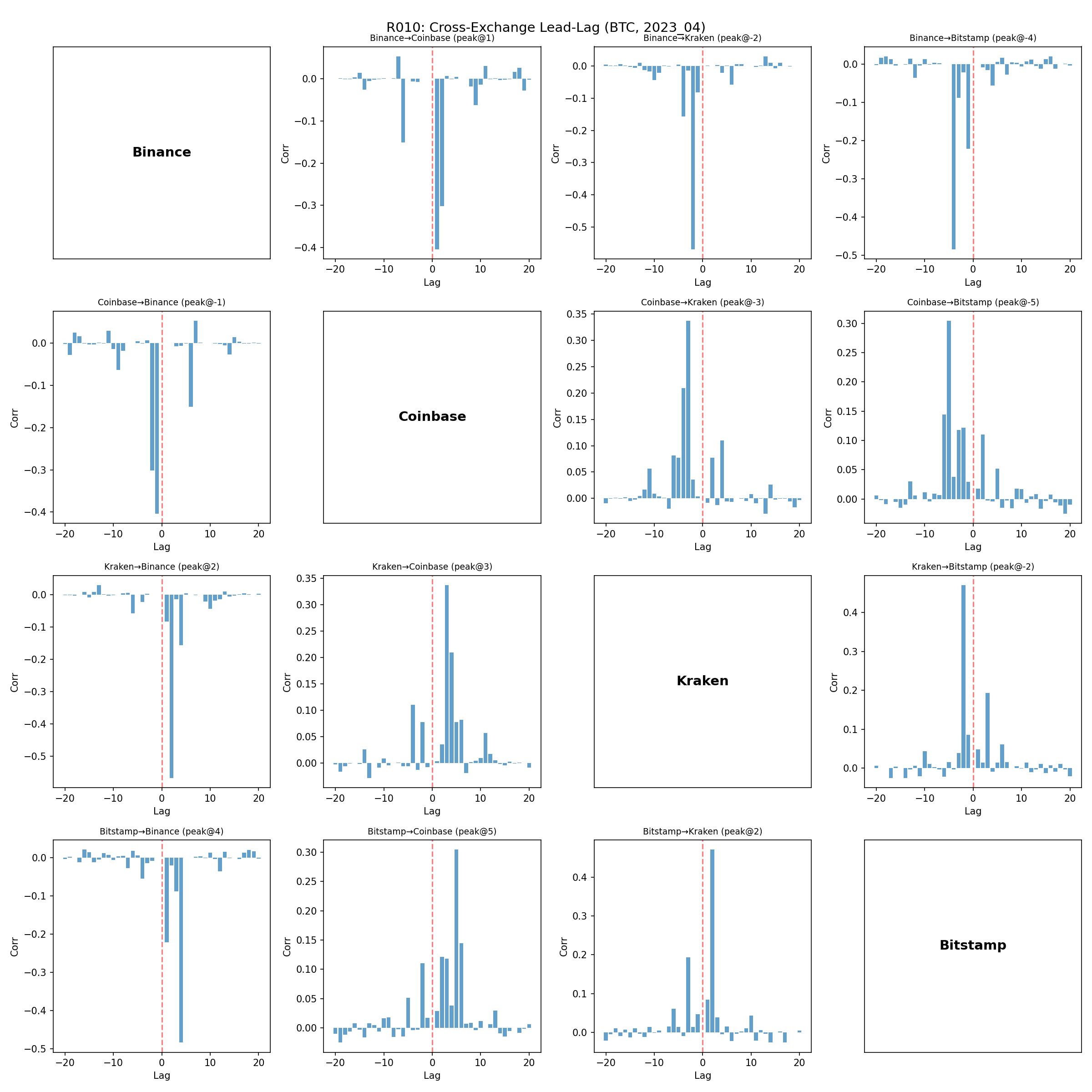
R010: Lead-Lag & Hasbrouck Information Share
Kaiko Trades Cross-exchange Granger causality
R004: Kyle's Lambda (Price Impact)
Kaiko OB OFI regression per snapshot
R013: Order Flow Imbalance → Price
Kaiko OB OFI beta regression, R² analysis
| Exchange | OFI Beta | R² | p-value |
|---|---|---|---|
| Kraken | 0.000170 | 1.5% | <0.001 |
| Binance | 0.000101 | — | <0.01 |
| Coinbase | — | — | not sig. |
III. Cross-Market Analysis
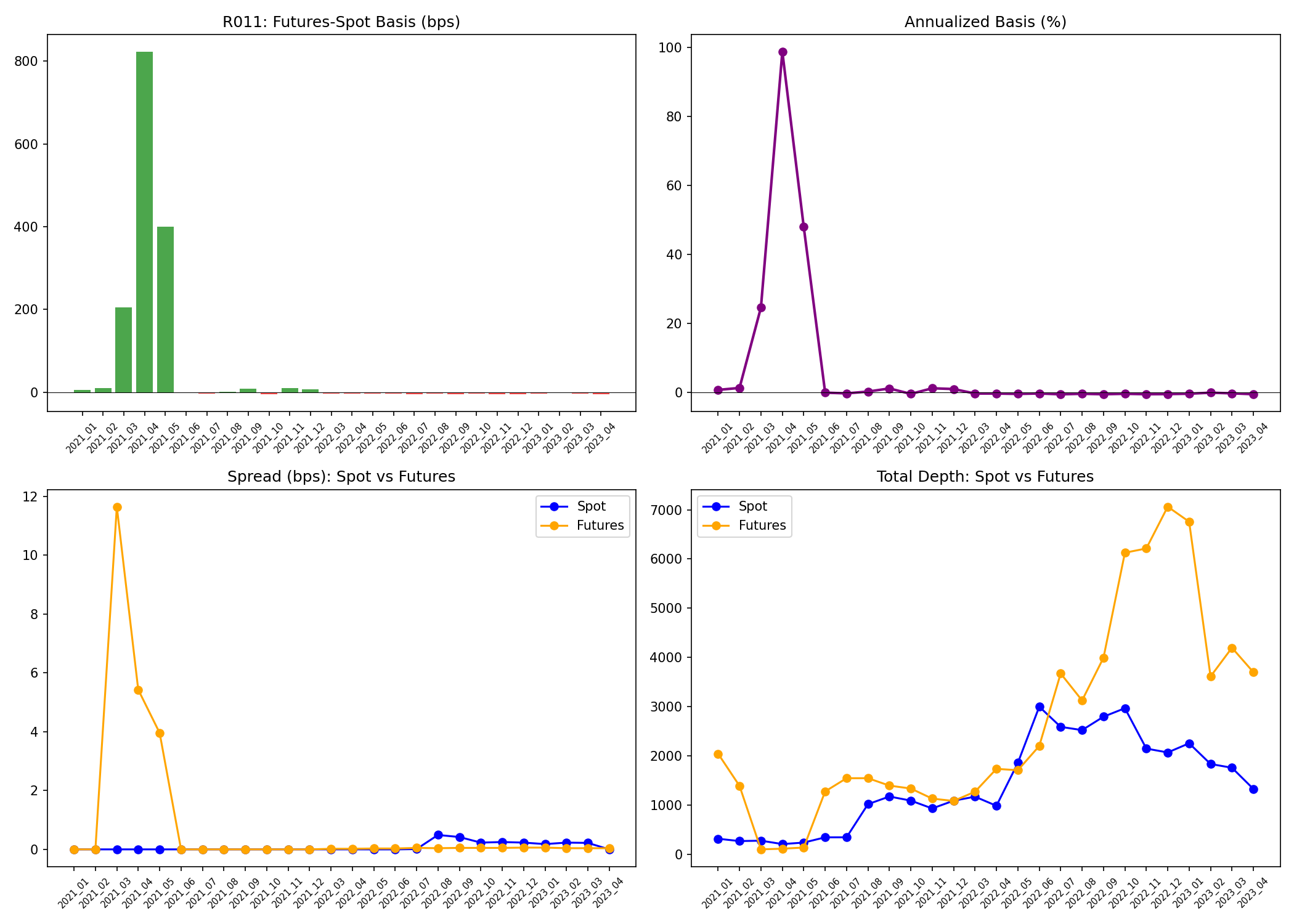
R011: Futures vs Spot Basis
Kaiko OB Binance Futures vs Spot | Monthly analysis
R018: Spot vs Futures Depth Ratio
Kaiko OB Futures/Spot depth comparison
R006: Crypto Stocks vs Traditional Market (WRDS CRSP)
WRDS COIN · MSTR · MARA · RIOT vs SPY · QQQ · GLD · TLT
| SPY | QQQ | GLD | TLT | |
|---|---|---|---|---|
| COIN | 0.49 | 0.52 | 0.06 | ~0 |
| MSTR | 0.50 | 0.55 | 0.09 | ~0 |
| MARA | 0.49 | 0.53 | 0.06 | ~0 |
IV. Temporal Patterns
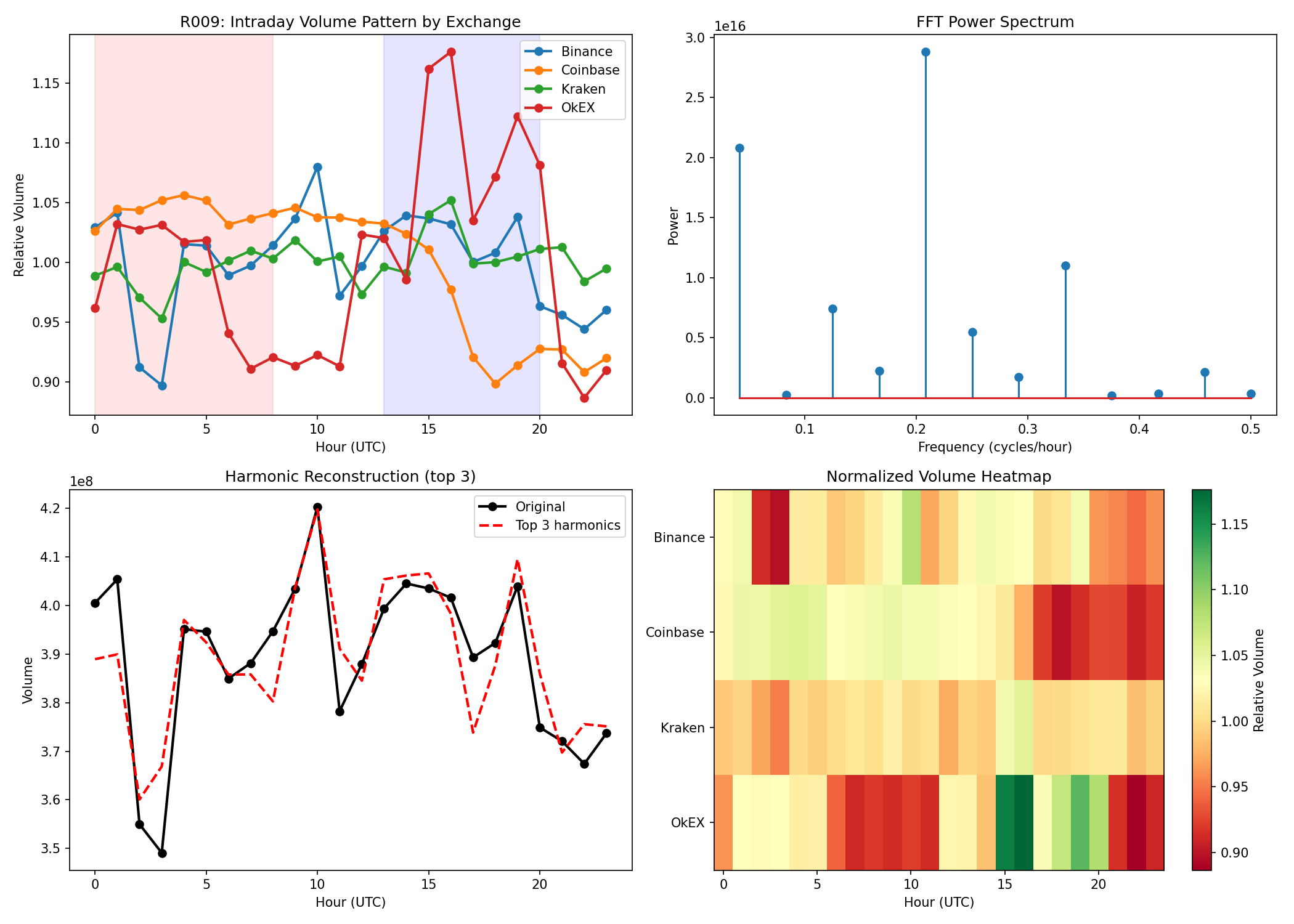
R009: Intraday Periodicity (FFT Decomposition)
Kaiko Trades FFT of hourly volume
R019: Spread Convergence Trend (2017–2023)
Kaiko OB Monthly median spread evolution
V. Deep Learning (V100 GPU)
GPU01: Convolutional Autoencoder — Market Regime Discovery
PyTorch Conv1D AE → 16-dim latent → K-means
GPU02: Ledoit-Wolf Covariance → Min-Variance Portfolio
WRDS+GPU 12 assets (crypto equities + indices) | Ledoit-Wolf shrinkage
GPU03: Transformer Price Predictor
PyTorch 4-exchange × 64-step | 156K params
Methods & Data
- Data: Kaiko consolidated order book (OB10-v2), 58 exchanges, 2017–2023. WRDS CRSP daily stock file.
- Infrastructure: Cornell research3 (112-core), research1 (88-core + 2× Tesla V100 32GB), BioHPC (SLURM cluster).
- Libraries: Python 3.12, pandas, numpy, scipy, matplotlib, PyTorch 2.5, scikit-learn.
- Automation: ComeWealth agent — autonomous multi-server research orchestration with parallel task execution.